Featured events


7-9 September 2012
Brussels Games
Brussels

Brussels Gay Sports will offer a weekend of fun and fairplay in the capital of Europe, with volleyball, swimming, badminton, and tennis, as well as fitness and hiking.

Learn more HERE.
26-28 October 2012
QueergamesBern
Bern, Switzerland

The success of the first edition of the QueergamesBern proved the need for an LGBT multisport event in Switzerland. This year will be even bigger, with badminton, bowling, running, walking, floorball.

Learn more HERE.
17-20 January 2013
Sin City Shootout
Las Vegas
The 7th Sin City Shootout will feature softball, ice hockey, tennis, wrestling, basketball, dodgeball, bodybuilding and basketball.

Learn more HERE.

13-16 June 2013
IGLFA Euro Cup
Dublin
After this year's edition in Budapest at the EuroGames, the IGLFA Euro Cup heads to Dublin for 2013, hosted by the Dublin Devils and the Dublin Phoenix Tigers.

Learn more HERE.

Friday, December 2, 2011

A hockey player's story of (not?) coming out

From the Concordian, the independent student newspaper from Concordia University in Montreal:

Almost 100 years after the first NHL season in 1917-18, the reputation of hockey being a “man’s sport” is still very much upheld. The sport teaches boys from a young age what it means to be a man and to be tough. With expressions like “don’t be a fag,” the sport also demonstrates some homophobic tendencies. So where, in such a “manly” sport, does a gay man fit in?

Because of the stigmas surrounding the sport, many gay players feel that it is easier for them to just stay in the closet rather than go through the hard phases of looking for tolerance and, perhaps more importantly, acceptance.

Jeff McDonald [name changed] used to play hockey at the university level. He’s played hockey since he was six years old, and has known he was gay since about the age of four. His parents were accepting and supportive from the very beginning.

Keep reading HERE.

Compete looks at new sexual orientatio protections in US pro sports contracts

Ty Nolan has a great look in Compete  at the latest news on recent advances in US pro sport.


Ah, the drama behind the scenes of NBA and MLB contracts. I've written an extensive article on how the major sports franchises are dealing with sexual orientation in their new contract negotiations. At the time I had to send the article to the publisher, I had not heard back from the MLB. I included the fact the San Francisco Giants became the first MLB team to offer domestic partnerships and protections for LGBT employees because San Francisco had passed legislations any company doing business with the City had to reflect their values on equality.

Now I can bring you "the rest of the story." The good news after the NFL recently made headlines for protecting gay players the--MLB has added sexual orientation as a protected class in terms of employment. One of the most vocal advocates for equal opportunity employment has been Rafael McDonnell, the Communications and Advocacy Manager for Resource Center Dallas, the city's Gay and Lesbian Center. After reading about the NFL inclusionary CBA language, he contacted both the NBA and the MLB to see if they would include the changes as well. I'm including a detailed time line of his experiences as well as one of the letters he received in response.

Keep reading HERE.

The New York Times looks at the redevelopment of Cleveland

From a New York Times story on the rebirth of the University Circle district of Cleveland, part of a concentrated effort by civic leaders to build a new Cleveland for the future:

[In] recent years Cleveland’s municipal government and its Regional Transit Authority have rallied major employers, banks, foundations and developers around a central goal of rebuilding the city’s core according to the new urban market trends of the 21st century — health care, higher education, entertainment, good food, new housing and expanded mass transportation.

A point of focus has been the emerging Uptown arts and entertainment district along Euclid Avenue, near where John D. Rockefeller and other industrialists and financiers built opulent mansions.

When it is finished next year, the new $27 million Museum of Contemporary Art, designed by Farshid Moussavi, will perch, like a lustrous black gem, at the entrance to the district, at Euclid and Mayfield Road. A pedestrian plaza designed by James Corner Field Operations, a designer of the High Line elevated park in New York City, separates the new museum from two four-story, mixed-use residential buildings under construction on the north and south sides of Euclid.

[...]

One of the first major projects for Uptown, completed in 2008, was the $200 million reconstruction of Euclid Avenue, which included installing a dedicated lane for an unusual bus rapid transit line. The three-year-old line has attracted 12 million riders and connects the city’s central Public Square to University Circle.

The bus service, known as the HealthLine, and the reconstructed boulevard are credited with contributing to a boom in development that The Plain Dealer reported in July had reached a total of $5 billion. Along with Uptown, where the investment so far totals $162 million, other big projects include a $560 redevelopment of University Hospitals Case Medical Center, a $350 million casino on Public Square and a $465 million, 555,000-square-foot convention center and medical mart downtown.

“There were skeptics about the HealthLine,” said David Beach, an urban design expert with the Museum of Natural History. “It’s proving that an investment in transit and improvements in streetscape do start to change real estate investment patterns over time. In a slow economy it takes a few years. But we are seeing new development up and down the Euclid corridor now.”

Read in full HERE.

That's all for now for photos from first day of FSGL conference in Paris

Today was the first day of the FSGL conference entitled "Sport and homosexuals, sport for homosexuals: models of integration, examples of rejection".

The themes of today's sessions were "Homosexuals as seen by the world of sport" and "Bodies in/at play", with two panel discussions: "Can out athletes live their passion?" and "Can sport be for women?"

The opening remarks were from Thierry Maudet, director of the French national sports institute, with Monique Amiaud of the institute participating in the final panel discussion.

It's still possible to register at no cost at fsgl.org for tomorrow's sessions at Paris City Hall.

Here are some photos from the panel discussion: "Can sport be for women?":

Chris Fanuel, Annie Sugier, Fabienne Gillonnier, Monique Amiaud, Philippe Liotard, Myrtille Rambion

Chris Fanuel, Annie Sugier, Fabienne Gillonnier, Monique Amiaud

Chris Fanuel, Annie Sugier, Fabienne Gillonnier, Monique Amiaud, Philippe Liotard, Myrtille Rambion

Fabienne Gillonnier, Monique Amiaud, Philippe Liotard


Yet more photos from first day of FSGL conference in Paris

Today was the first day of the FSGL conference entitled "Sport and homosexuals, sport for homosexuals: models of integration, examples of rejection".

The themes of today's sessions were "Homosexuals as seen by the world of sport" and "Bodies in/at play", with two panel discussions: "Can out athletes live their passion?" and "Can sport be for women?"

The opening remarks were from Thierry Maudet, director of the French national sports institute, with Monique Amiaud of the institute participating in the final panel discussion.

It's still possible to register at no cost at fsgl.org for tomorrow's sessions at Paris City Hall.

Here are some photos from the round table "Can out athletes live their passion?":

Maële Bigi, Florian Bou, Philippe Liotard, Brigitte Boréale, Braïm Nait-Balk

Brigitte Boréale, Braïm Nait-Balk

Maële Bigi, Florian Bou, Philippe Liotard

Florian Bou, Philippe Liotard

Maële Bigi, Florian Bou, Philippe Liotard, Brigitte Boréale, Braïm Nait-Balk

Even more photos from first day of FSGL conference in Paris

Today was the first day of the FSGL conference entitled "Sport and homosexuals, sport for homosexuals: models of integration, examples of rejection".

The themes of today's sessions were "Homosexuals as seen by the world of sport" and "Bodies in/at play", with two panel discussions: "Can out athletes live their passion?" and "Can sport be for women?"

The opening remarks were from Thierry Maudet, director of the French national sports institute, with Monique Amiaud of the institute participating in the final panel discussion.

It's still possible to register at no cost at fsgl.org for tomorrow's sessions at Paris City Hall.

Here are some photos from the second session on "Bodies in/at play", which featured talks based on an extensive study of HIV-positive persons and their relation to sport:
Estelle Duval

Estelle Duval, Sylvain Ferez

Sylvain Ferez

Sylvain Ferez

Xavier Pavie

More photos from first day of FSGL conference in Paris

Today was the first day of the FSGL conference entitled "Sport and homosexuals, sport for homosexuals: models of integration, examples of rejection".

The themes of today's sessions were "Homosexuals as seen by the world of sport" and "Bodies in/at play", with two panel discussions: "Can out athletes live their passion?" and "Can sport be for women?"

The opening remarks were from Thierry Maudet, director of the French national sports institute, with Monique Amiaud of the institute participating in the final panel discussion.

It's still possible to register at no cost at fsgl.org for tomorrow's sessions at Paris City Hall.

Here are some photos from the first session on "Homosexuals as seen by the world of sport":
Lindsay England


Lindsay England and Xavier Pavie

Julie Gaucher

Philippe Liotard

Photos from first day of FSGL conference in Paris

Today was the first day of the FSGL conference entitled "Sport and homosexuals, sport for homosexuals: models of integration, examples of rejection".

The themes of today's sessions were "Homosexuals as seen by the world of sport" and "Bodies in/at play", with two panel discussions: "Can out athletes live their passion?" and "Can sport be for women?"

The opening remarks were from Thierry Maudet, director of the French national sports institute, with Monique Amiaud of the institute participating in the final panel discussion.

It's still possible to register at no cost at fsgl.org for tomorrow's sessions at Paris City Hall.

Here is a selection of photos of the venue and the opening session:

FSGL president Christelle Foucault

INSEP director Thierry Maudet

Philippe Liotard, scientific committee

Dominique is one of the many volunteers at the event
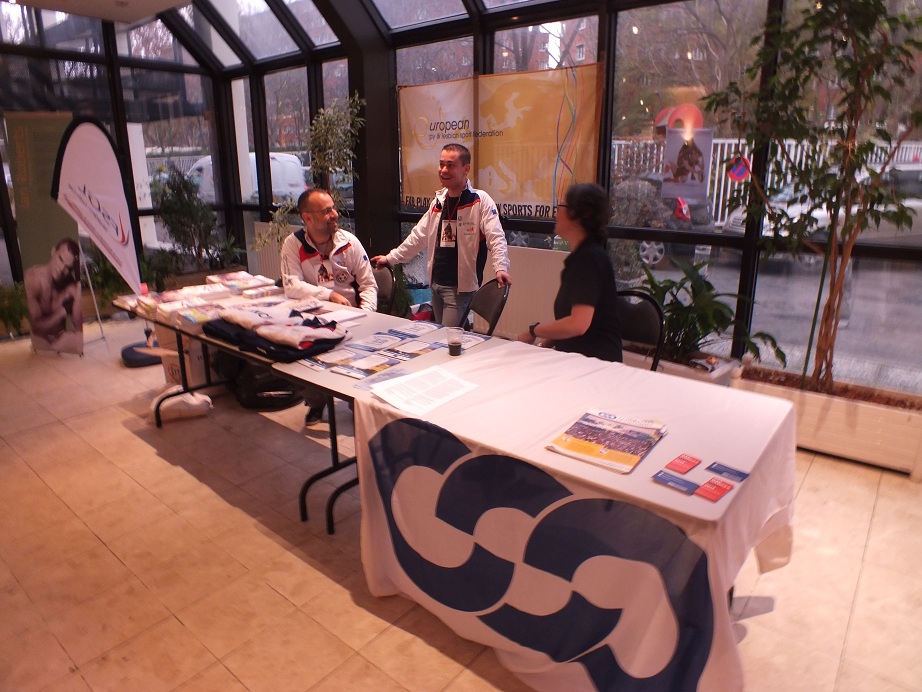
EGLSF exhibition: "Against the Rules"

FSGL, EGLSF, and FGG info


Pierre Deransart and Lindsay England

Conference coordinator Christelle Lagattu

Athletes, activists, academics in the audience

Christelle Foucault and Thierry Maudet

Journalist from leading French TV network and pentathlete Florian Bou


Thursday, December 1, 2011

Biillie Jean King receives Civic Leadership award

Our congratulations to Gay Games Ambassador Billie Jean King:

The Preston Robert Tisch Award in Civic Leadership is an annual Aspen Institute Award, funded by the family of the late Preston Robert Tisch to carry on his legacy of leadership, public service and philanthropy. The award is presented annually to an individual who has had a positive impact on his/her community, who embodies the broad Aspen Institute ideal of values-based leadership, and who has exemplified this ideal in innovative ways that can serve as models for other leaders.

Billie Jean King – Sports Icon and Humanitarian; Founder, Women's Sports Foundation; Co-Founder, World TeamTennis

An innovator in the area of sports and social change, Billie Jean King has created new inroads for both genders in and out of sports during her legendary career. The winner of 39 Grand Slam singles, doubles and mixed doubles tennis titles, including a record 20 titles at Wimbledon, she was named one of the “100 Most Important Americans of the 20th Century” by Life Magazine. King was one of nine players who broke away from the tennis establishment in a move that led to the birth of women’s professional tennis and the formation of the Virginia Slims Tour and the Women’s Tennis Association. She also founded the Women’s Sports Foundation and co-founded World Team Tennis, a ground-breaking co-ed professional tennis league. Her defeat of Bobby Riggs in 1973—dubbed “The Battle of the Sexes”—is still remembered for its effect on society and its contribution to the women’s movement. In 2006, the National Tennis Center, home of the U.S. Open, was renamed the USTA Billie Jean King National Tennis Center in honor of King’s contributions to tennis, sports and society, both on and off the court.

Billie Jean King has received numerous other honors including being named a Global Mentor for Gender Equality by UNESCO in 2008 and receiving in 2009 the NCAA President’s Gerald R. Ford Award, recognizing her contributions to improving higher education and intercollegiate athletics. That same year, President Obama awarded her the Presidential Medal of Freedom, the nation’s highest civic honor. She continues to be a leader in the fight for equality and recognition in the GLBT community and has also been honored by many of the leading GLBT organizations, including the Human Rights Campaign, GLAAD and Lambda Legal Foundation.

Remembering Dr Tom Waddell on World AIDS Day

We're going to adapt a post from Team Chicago, because it's pretty fine:

On World AIDS Day, we celebrate Dr. Tom Waddell, a physician, a humanitarian, an Olympic athlete, and the founder of the Gay Games. The Gay Games is the largest international sporting event open to all, including POZ athletes and artists.

We celebrate the many lives lost, and the many people who survive, and who join us every four years at each Gay Games.

We will have more news in coming weeks on the issue of AIDS, and in particular our hopes for the most welcoming Gay Games ever for HIV-positive people in 2014 in Cleveland+Akron.

In 2012, let's let the three interlocked rings of the Federation of Gay Games logo stand for:


Zero new HIV infections
Zero discrimination
Zero AIDS-related deaths

And let the fact that they are interlocking rings remind us of the need for solidarity between people with AIDS and others, between rich and poor, between regions of the world.

Elton John in Sydney on World AIDS Day


News via the foundation of Gay Games Ambassador Elton John:

Sir Elton John, founder of EJAF, gave an impassioned speech to crowds in Sydney, Australia for World AIDS Day.

He emphasised the gains that have been made in fighting HIV and AIDS, "We've got this disease really by the scruff of the neck," he said. Sir Elton warned that the world needed to be prepared to "fight a new war, to get the funding necessary to actually kill the disease once and for all ... we can't let go now," he urged, "it's imperative we seize this opportunity where the end is maybe in sight, to keep going".

With the cutting of a red ribbon, Sir Elton unleashed fountains of fireworks which twinkled over the harbour while the iconic Sydney Opera House was illuminated in a sombre red hue to mark the day. An estimated 30,000,000 people have died from AIDS-related causes since the disease was first identified in the 1980's and currently 34,000,000 people are living with HIV.

Cleveland commermoration of World AIDS Day


World AIDS Day candlelight march beginning at Cleveland City Hall at 5:30PM. The city's landmark buildings will go dark for approximately 3 minutes, and when they come back on, Terminal Tower will be lit in a deep red color.

Tackling AIDS through sport (in Africa...)

A 2008 discussion paper from the UK Departments International Development and of Culture, Media and Sport (no homos in sport, apparently).


This paper analyses the role of sport in tackling AIDS primarily in Africa. The case studies in this paper demonstrate the potential of sport and its capacity to embody many of the essential policy actions for HIV prevention and describes initiatives that build and maintain leadership, equity, supports the empowerment of young women and men and promotes knowledge of transmission and prevention.

These programmes are based on the principles of mobilising community based responses and targeting the HIV prevention needs of key vulnerable groups. This paper identifies the main ways in which sport can be used to tackle AIDS including using sports programmes and activities as a way to engage young people and provide a platform for education and information about HIV and AIDS.

Various approaches are considered in greater detail and examples highlighted where they are being successfully put into practice. It also reviews the existing evidence supporting sports interventions and identifies where additional research and evaluation is needed.

Download HERE.