Featured events


7-9 September 2012
Brussels Games
Brussels

Brussels Gay Sports will offer a weekend of fun and fairplay in the capital of Europe, with volleyball, swimming, badminton, and tennis, as well as fitness and hiking.

Learn more HERE.
26-28 October 2012
QueergamesBern
Bern, Switzerland

The success of the first edition of the QueergamesBern proved the need for an LGBT multisport event in Switzerland. This year will be even bigger, with badminton, bowling, running, walking, floorball.

Learn more HERE.
17-20 January 2013
Sin City Shootout
Las Vegas
The 7th Sin City Shootout will feature softball, ice hockey, tennis, wrestling, basketball, dodgeball, bodybuilding and basketball.

Learn more HERE.

13-16 June 2013
IGLFA Euro Cup
Dublin
After this year's edition in Budapest at the EuroGames, the IGLFA Euro Cup heads to Dublin for 2013, hosted by the Dublin Devils and the Dublin Phoenix Tigers.

Learn more HERE.

Showing posts with label ggv. Show all posts

Sunday, July 29, 2012

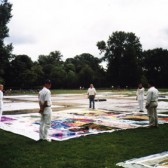
A look back at Gay Games V AIDS Memorial Quilt display


In 1998 there took place a traveling exhibition of AIDS memorial quilts from different European countries, throughout Europe. The final display was in the Vondelpark in Amsterdam, from 1 to 3 August, to celebrate the Gay Games. At the exhibition were also quilts from non-European countries to see, like in Chile, Mexico, Cuba and Thailand. As reported by Marleen Swenne:

A quilt consists of eight name flags sewn together, each made in memory of someone on the impact of AIDS is deceased. Some name flags are simple and clear, others look busy and seem imbued with personal memories of the deceased. Each name flag is a precious thing. You look at it that the people who stayed behind the flag name with great care and love have put together. Sometimes there is a picture on the canvas and usually there is a name to read. But there are also quilts with no names, like the quilt from Chile. The taboo against AIDS is so great that it is dangerous even for the survivors to put the name of the deceased on the quilt.

The opening day was a cloudy Saturday with constantly threatening rain. The puddles have been vacuumed up as best could be done. After the opening speeches Erik Windhorst plays ‘The Rose’ on his bagpipes. In the background a young athlete tunes her stretching exercises to the mournful music.

There is also a quilt where every passerby can write the name of a loved one who is deceased, and not just people with AIDS. This is the Gay Games V quilt. During each Gay Games such a quilt is created, and it never emains empty.

A ritual that often takes place in quilt exhibitions is the reading of names of the deceased. People of various nationalities were on stage throughout the day to read the names.

Toi is from Thailand. On Sunday he is one of the people reading names. The context is poignant and painful, but as Toi gets ready, he keeps smiling, and walks to the stage where the two Thai quilts can be seen. They are very colorful, almost every name flags have a picture of something or other. A frog. A cat. Fish. A bridge. “That flag is the name of someone who lived on the river. When they started building a large modern bridge, he had to move. He did not, but was forced to leave. We sewed the bridge on his quilt.”

The Chewit Names Project in Nonthaburi, where Toi works, focuses on supporting and enhancing the resilience of people with HIV. There is a telephone helpline, where many ideas and experiences are exchanged. It is also possible to give information to students and prostitutes. Toi: “We have no money for proper medication to do more. Nor do the patients or the government. And there is no insurance. A few people get medication from the hospital. So we focus on other aspects of health care. We do a lot with herbs, massage and meditation. People feel better with. all we can do.”

Toi is a painter, but he can not earn a living. He talks about the Chewitt Project, where art is used as a means to understand AIDS. From this project came the two quilts displayed at Vondelpark. “Making art means that you have a thought process in a very personal way of shaping. We work with students so they can design and make their own educational materials. They use them again for information on their schools and their communities. It is a positive way of working I think: you give your feelings shape, you can express commitment to people with HIV, or show that you sympathize with those who someone with HIV in the family.”

Sunday and Monday were two sunny days when many people viewed the quilts. The names will be read again, endless rows of names. In between music sounds. “Are there really so many people who’ve died, mama?” A child’s voice sounds clear across the grounds. The child’s mother tries to explain to her daughter. The adults, no less impressed, look at all those names and are quiet. A few hundred meters away football players practice for their Gay Games competition. Birds sing, the sun shines. “You must live,” said Toi. And he smiles.

Saturday, July 21, 2012

My Gay Games story: Jim Atkinson, London

Jim Atkinson at Gay Games VI, Sydney (photo Outsports)
At the age of 59, I can look back on a career as a coach in a variety of sports which goes back to my late 20s. The rewards and satisfactions are simply one of the most important aspects of my life. It has been an interesting and often inspiring journey — and it's not yet over! For many of those years, I combined coaching as a hobby with my 'real' job as an openly gay senior development manager in The Sports Council, the British organisation which oversees and funds the development of sport from community participation to Olympic medals.

I've known I was attracted to men since my very early teens growing up in Belfast, Northern Ireland. It was a household which took religion seriously, so the question of my sexuality was a continuing source of conflict and anxiety which I never shared with anyone. The idea of homosexuality was such an unsettling one that I simply had to find a way to diffuse the anxiety. Sport was my mechanism! My older sister was an international-level athlete who ran for Great Briatin, my parents played sport, and I had all the support I could have wanted in getting involved. I loved sport, I was quite good at it and, after all, homosexuals didn't play sport so no one could ever suspect me of being "queer," could they?

It was many years before I understood how absurd that idea was, but until my mid-twenties it was my defense mechanism of choice. The fact that I didn't have sex with anyone at all till I was 26 meant that the point was academic for many of these years!

To cut a long story short, I played field hockey at school and university, often captaining the side, and eventually became a national league player. I played tennis for my club, and squash at a good standard, but weightlifting became my passion.

I was always a small man, and weights allowed me to become a lot stronger and more powerful — even if not bigger! While completing my master's degree in Experimental Psychology, I "moonlighted" as an instructor in my gym, and the experience was crucial in making me want to coach sport. I loved the interaction with the trainees and I discovered the great rewards of helping people achieve their goals.

The gender of the trainees didn't matter. OK, I knew I was attracted to men (and eventually at 26 did something about it!) but it was the personal interaction which counted. It wasn't an excuse for being with cute men in workout gear!

It helps, of course, that my "take" on sport is almost entirely a "sex-free zone." I've never had much interest in the sort of "Locker Room" fantasy which many gay men enjoy. I've shared shower and locker rooms with literally thousands of naked men since I was 10 and never once felt the smallest hint of sexual arousal. I guess familiarity has completely defused and desensitised any erotic content!

Over a period of 30 years, I have qualified as a coach in field hockey, weightlifting, powerlifting and boxing, and in each of these sports I've been "out." Indeed, the most recent coaching in the Amateur Boxing Club was at their request. They had already made me secretary of the club, knowing I was gay, and they paid the fees for the 5-day course it took to become qualified. My partner Phil also boxes at the club and we simply couldn't have been made more welcome. Fitzroy Lodge is one of the biggest and longest established Amateur clubs in the United KingdomK and has produced many National Champions since it was founded in 1908.

Boxing also been the occasion of an amusing incident and one of the most interesting conversations I've had on the issue of gay sexuality. Two years ago I was with a party of Metropolitan Police and club boxers from London competing against the NYPD (we won!). While being driven round New York in an NYPD police truck, the London boxers and I discussed the issue of gay men parenting. I thought the NYPD officer driving the truck was going to crash! He seemed astonished at what we were discussing, very calmly and rationally, from my perspective as a gay man. Perhaps it's time to question easy assumptions about homophobia in a sport which is often referred to as a bastion of macho conservatism!

The journey from paranoid and closeted teen to openly gay man who played and coached sport on his own terms has been a truly liberating one, and the Gay Games has played its part in making the journey so rewarding. I owe the Federation of Gay Games a great deal — even though I had been "out" in sport for 15 years before I came to NYC in '94. Amsterdam in '98 and Sydney in 2002 just reinforced the positive feelings I have for the Gay Games — although two bronze, one silver and one gold medals obviously helped! To march into a packed Yankee Stadium in '94, together with a wonderful young wrestler from Philadelphia (who I had met that week and who is still a friend), me with my bronze medal, he with his silver, was such an overwhelming emotional experience that I can recall the tears I shed even now. Nothing in my sports experience over almost 50 years can match it!

But what of my experience as an 'out' gay sportsman, sports administrator and coach? Well, I have to report no great trauma, no confrontations, no rejection, no negative comments or overt homophobia. I know it exists. I've just never experienced it at first hand.

For me the rewards of coaching come not just from working with the very talented, but also those who came late to sport — like my long-time partner, Phil. He was even smaller than I as a boy and, as he now describes it at the age of 39, he hated sport with a passion. His physical education at school simply betrayed him. He wasn't good at ball games, hated team sports and was physically small.

Rugby was out of the question and cricket bored him witless. So he did nothing. It was only in his 30s, having hooked up with me, that he discovered that he is a talented runner, loves weightlifting (very strong for his weight) and has become an enthusiastic boxer. Where were the opportunities and the coaches to introduce him to these activities when he was in his teens and twenties? Nowhere to be seen.

My own regular sparring partner at the club, Minh, a Chinese guy in his mid-twenties, always wanted to box, never had the chance when he was younger and was physically small and a shy person. Now he is become a very talented boxer and his girl friend says he is a much happier and fulfilled personbecause of it.

I could go on and on. The thrill of helping people — especially those from unlikely backgrounds — to be the "best that they can be" in sport, is a huge motivation. I don't propose to give it up any time soon! I applaud the FGG and its dedicated volunteers for making a good experience of sport a reality for so many thousands. Long may it continue.

-- Jim Atkinson, London, 21 April 2005

Friday, May 4, 2012

HIVOS on the impact of the Gay Games V international human rights conference on gay emancipation in developing countries

Hivos (Humanistisch Instituut voor Ontwikkelingssamenwerking) is a Dutch organization for development co-inspired by humanist values. Hivos provides financial and political support to over 800 partner organizations in over 30 countries in Africa, Latin America, Asia and Southeastern Europe. Along with these local organizations, Hivos seeks to contribute to a free, fair and sustainable world, where women and men have equal access to resources and opportunities for development. Hivos is convinced that if people have a fair chance, their possibilities are almost limitless. Hence the slogan "People unlimited ". An important guiding principle is to strengthen the social position of women, along with work in the area of HIV/AIDS.

From the HIVOS webpage on their gay emancipation policy:


In 1998, Hivos decided in association with Amnesty International to make it possible for activists from developing countries to participate in the international human rights conference of the Gay Games in Amsterdam. Their participation resulted in widespread publicity and a substantial increase in the number of activities in the field of gay emancipation in developing countries. It was the breakthrough needed to launch a true global gay emancipation movement, which until then had been dominated by Europe and the United States. It was also during this period that international gay emancipation started to appear on the agenda of national governments, including in the Netherlands.

A look back at Gay Games V human rights workshop

From the website of the Global Alliance for LGBT Education, created at Gay Games V, Amsterdam, 1998:

In 1998, Amnesty International and HIVOS organized a human rights conference alongside the Gay Games in Amsterdam. Empowerment Lifestyle Services was asked to organize a workshop on education against homophobia. This was the first global workshop on this theme.

Participants

The workshop had 5 speakers and was attended by about 20 people from every continent. The speakers were Toni Reis from Brazil, Alan Segal from Canada, Anna Leah Sarabia from the Philippines, XXX from South Africa and Peter Dankmeijer from the Netherlands.

Challenges

When Empowerment organized the workshop, it became obvious there were some basic challenges when discussing education about LGBT issues across cultures. The first question of the invited speakers was: what do you mean by “education”. This was a very valid question. Are we talking about formal education (schools, training) or informal education (learning on the spot, theme sessions)? Which kinds of schools or other formal education are we talking about? Which kinds of target groups: children, teenagers, heterosexuals, LGBT constituencies, professionals? For the sake of the workshop, Empowerment decided to focus on education of heterosexual young people in order to combat homophobia, especially in schools.

Differences and similarities

During the workshop, it became clear educational work differs in some ways, but it resembles in other ways. The divergences seemed to be mainly due to social and political contexts, which determined access to the school system and to young people. In a more conservative context, it is more difficult to get access.
But once educators have access, the discussions they have with young people seem to be very similar all over the world. Most young people are surprised and ask lots of (the same basic) questions. Some are afraid and angry; those kids and their often fundamentalist religious parents pose the biggest challenge for educators.

Recommendation

The recommendation of this workshop was to create a global network for exchange and to raise the quality of the work. This would be especially useful for the exchange of best practices on how to discuss homophobia and heteronormativity.

Monday, June 27, 2011

A song written on the occasion of Gay Games V


Thursday, June 16, 2011

A look back at 2002 study on the benefits of Gay Games participation

We just stumbled across a 2002 paper published in the Journal of Applied Sport Psychology, entitled: "Social Psychological Benefits of Gay Games Participation: A Social Identity Theory Explanation" and based on research done among women participating in Gay Games V. Here's an extract:

Another common theme that emerged from the data was the positive memories that participants would take back with them. Participants summarized this point in saying, “I leave with some amazing memories” and “a memory to hang on to for life.” On one hand, positive memories may be considered a fairly benign effect of participation. Yet on the other hand, these memories may help sustain the immediate effects of participation on their personal and social identities. As one athlete stated, “[The Gay Games] will be a lasting memory in my life forever. [I] will always savor this week!!”

Read in full HERE.

Friday, January 28, 2011

In het Nederlands: Kluun: In zijn roman "Haantjes" blikt hij terug op de Gay Games V


From Bol.com:

In januari verschijnt Haantjes, Kluun's derde roman, gebaseerd op een waargebeurd zakelijk fiasco.

Amsterdam, 1998. Iedereen verdient geld. De beurs floreert, de reclamewereld bloeit, het nachtleven bruist. RoXY en iT zitten wekelijks vol, Amsterdam is on top of the world. In dat jaar beginnen Stijn en Frenk, voor de lezers van Komt een vrouw bij de dokter en De weduwnaar geen onbekenden, hun creative & marketing agency Merk in Uitvoering. Het gaat ze voor de wind. Tot Charles 'de schuld van alles' langskomt met een briljant idee voor de GayGames, die in de zomer van 1998 in Amsterdam worden gehouden. Niet gehinderd door enige kennis van de gayscene danwel door het kritische commentaar van vrouwen in hun omgeving, besluiten Stijn en Frenk Merk in Uitvoering nu eens écht op de kaart zetten.

Kluun's bruisende roman Haantjes is een terugblik op het leven van Stijn en Carmen, toen hun yuppenbestaan nog zonder zorgen was. Hoewel, wie zorgt er voor de amper drie maanden oude Luna, nu Stijn elke avond met GayGames-souvenirs op pad moet?

Dit boek verschijnt in een witte en een roze uitvoering en worden assorti geleverd.