Featured events


7-9 September 2012
Brussels Games
Brussels

Brussels Gay Sports will offer a weekend of fun and fairplay in the capital of Europe, with volleyball, swimming, badminton, and tennis, as well as fitness and hiking.

Learn more HERE.
26-28 October 2012
QueergamesBern
Bern, Switzerland

The success of the first edition of the QueergamesBern proved the need for an LGBT multisport event in Switzerland. This year will be even bigger, with badminton, bowling, running, walking, floorball.

Learn more HERE.
17-20 January 2013
Sin City Shootout
Las Vegas
The 7th Sin City Shootout will feature softball, ice hockey, tennis, wrestling, basketball, dodgeball, bodybuilding and basketball.

Learn more HERE.

13-16 June 2013
IGLFA Euro Cup
Dublin
After this year's edition in Budapest at the EuroGames, the IGLFA Euro Cup heads to Dublin for 2013, hosted by the Dublin Devils and the Dublin Phoenix Tigers.

Learn more HERE.

Showing posts with label memorial. Show all posts

Sunday, July 29, 2012

A look back at Gay Games V AIDS Memorial Quilt display


In 1998 there took place a traveling exhibition of AIDS memorial quilts from different European countries, throughout Europe. The final display was in the Vondelpark in Amsterdam, from 1 to 3 August, to celebrate the Gay Games. At the exhibition were also quilts from non-European countries to see, like in Chile, Mexico, Cuba and Thailand. As reported by Marleen Swenne:

A quilt consists of eight name flags sewn together, each made in memory of someone on the impact of AIDS is deceased. Some name flags are simple and clear, others look busy and seem imbued with personal memories of the deceased. Each name flag is a precious thing. You look at it that the people who stayed behind the flag name with great care and love have put together. Sometimes there is a picture on the canvas and usually there is a name to read. But there are also quilts with no names, like the quilt from Chile. The taboo against AIDS is so great that it is dangerous even for the survivors to put the name of the deceased on the quilt.

The opening day was a cloudy Saturday with constantly threatening rain. The puddles have been vacuumed up as best could be done. After the opening speeches Erik Windhorst plays ‘The Rose’ on his bagpipes. In the background a young athlete tunes her stretching exercises to the mournful music.

There is also a quilt where every passerby can write the name of a loved one who is deceased, and not just people with AIDS. This is the Gay Games V quilt. During each Gay Games such a quilt is created, and it never emains empty.

A ritual that often takes place in quilt exhibitions is the reading of names of the deceased. People of various nationalities were on stage throughout the day to read the names.

Toi is from Thailand. On Sunday he is one of the people reading names. The context is poignant and painful, but as Toi gets ready, he keeps smiling, and walks to the stage where the two Thai quilts can be seen. They are very colorful, almost every name flags have a picture of something or other. A frog. A cat. Fish. A bridge. “That flag is the name of someone who lived on the river. When they started building a large modern bridge, he had to move. He did not, but was forced to leave. We sewed the bridge on his quilt.”

The Chewit Names Project in Nonthaburi, where Toi works, focuses on supporting and enhancing the resilience of people with HIV. There is a telephone helpline, where many ideas and experiences are exchanged. It is also possible to give information to students and prostitutes. Toi: “We have no money for proper medication to do more. Nor do the patients or the government. And there is no insurance. A few people get medication from the hospital. So we focus on other aspects of health care. We do a lot with herbs, massage and meditation. People feel better with. all we can do.”

Toi is a painter, but he can not earn a living. He talks about the Chewitt Project, where art is used as a means to understand AIDS. From this project came the two quilts displayed at Vondelpark. “Making art means that you have a thought process in a very personal way of shaping. We work with students so they can design and make their own educational materials. They use them again for information on their schools and their communities. It is a positive way of working I think: you give your feelings shape, you can express commitment to people with HIV, or show that you sympathize with those who someone with HIV in the family.”

Sunday and Monday were two sunny days when many people viewed the quilts. The names will be read again, endless rows of names. In between music sounds. “Are there really so many people who’ve died, mama?” A child’s voice sounds clear across the grounds. The child’s mother tries to explain to her daughter. The adults, no less impressed, look at all those names and are quiet. A few hundred meters away football players practice for their Gay Games competition. Birds sing, the sun shines. “You must live,” said Toi. And he smiles.

Wednesday, June 20, 2012

Sydney Gay Games quilt display leads to a commitment to preserve this legacy of lives

From Gay News Network:

Philip Diment’s work as convenor of the AIDS Memorial Quilt Project and service to the community was recognised in this year’s Queens Birthday Honours List. Alex Dunkin reports.

It has been 20 years since Philip Diment first began his work and involvement in the LGBT community and it has now culminated to being recognised in this year’s Queen’s Birthday Honours List.

The award – Member (AM) in the General Division of the Order of Australia – is in recognition of Diment’s service to the community as convener of the Australian AIDS Memorial Quilt Project which, in 2011, with the help of many supporters and donors, was relocated to a permanent home in the Powerhouse Museum.

The quilt itself is an evocative record of the discovery of HIV AIDS in Australia and the destructive impact on the lives of young same-sex attracted men in the 1980s and 90s. The multi-panel quilt depicts a time when ignorance toward the gay community was rife and the mostly 20- and 30-year-old men were left isolated with little help and potentially no friends as many had already passed away.

Preserving the memory of the quilt sparked Diment into action to ensure the initial impact HIV and AIDS had on the community is not forgotten.

“What inspired me was when I saw it during the last full display at the Gay Games in 2002,” Diment tells SX. “Unless something was done, it was going to end up in someone’s garage somewhere and not secured for the future.

Keep reading HERE.

Wednesday, April 4, 2012

Memorial Moment at Federation of Gay Games Annual Meeting

The Memorial Moment was inaugurated at the 1997 Annual Meeting in Denver, Colorado and has become an integral part of each Annual Meeting since.

This celebration was established to not only pay tribute to the members of our immediate and extended Gay Games family who have gone before us and to acknowledge their contributions to the Gay Games movement, but to also reflect upon the founding principles, goals and spirit of fellowship that unites us in our efforts to promote and support the Gay Games.

The Memorial Moment consists of three components:

1. Reading of names from the FGG Memorial List, to which additional names are added each year.

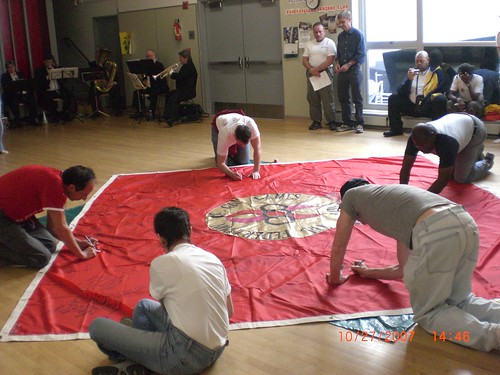
2. Ceremonial unfolding of the Federation of Gay Games Memorial Signature Quilt Square in the tradition established by the NAMES Project.

3. After the Quilt Square is unfolded, participants are welcome to write messages on the quilt and to make any public verbal statements of celebration concerning their loved ones.

As the Memorial Moment has evolved over the years, certain elements have been added optionally, such as musical accompaniment and dancing. During a Site Selection year, the Memorial Moment has had a healing and unifying effect, especially for the representatives and supporters of those cities that have not been selected to host the Gay Games.

The fact that we always make time within the busy schedule of every Annual Meeting to remember, honor and draw inspiration from the elders, upon whose shoulders we stand, is one of the hallmarks which distinguishes the Federation of Gay Games as we continue to work and build upon Tom Waddell’s revolutionary, transformative and empowering vision.

Sunday, February 19, 2012

Ross Hayduk hiking for the AIDS Memorial Grove

We are pleased to share some news from Ross Hayduk, former Team San Francisco delegate to the Federation of Gay Games.

Ross Hayduk, an inspiring friend to – and volunteer of – the National AIDS Memorial Grove, is embarking on an incredible journey. Inspired by the life of Dr. Tom Waddell (whose name was inscribed in the Grove in 2011), Ross became a Gay Games athlete in the 2002 and 2006 events, earning medals in Track & Field and Powerlifting. After participating in a 200-mile cycling event in 2010 and a 218-mile hiking event in 2011, Ross decided to combine his passions for endurance events and fundraising by planning to hike the 2,184-mile Appalachian Trail in 2012 to benefit the National AIDS Memorial Grove.

“I decided I could either traverse the Grove 7,688 times or hike 2,184 miles along the great American trail,” Ross jokes. “But as I hike, I will have a daily reminder of the beauty of this national memorial set in the heart of Golden Gate Park.” Inspired by the message of healing, hope and remembrance, Ross is investing his personal resources, as well as six months of his life, into a long-distance hike to draw attention to HIV-related health issues.

“I believe we can overcome challenges to our health like HIV, substance abuse, and bipolar depression, especially with the support of non-profit HIV/AIDS service organizations. But we must remember those who have gone before, who did not have the breadth of services available today. The only reason I am able to hike over two thousand miles is due to the sacrifices made by those whose names are inscribed within the Circle of Friends.”

Those interested in following his hike online [and donating] may visit www.HikeRossHike.org. Beginning in March in Georgia and ending in September in Maine, Ross looks forward to the adventure of a lifetime, trusting that his efforts will bring greater awareness to the National AIDS Memorial Grove in 2012.

Thursday, October 27, 2011

25th anniversary of the American Run for the End of AIDS

We are currently in the midst of the 25th anniversary of the American Run for the End of AIDS which took place from 1 March 1986 to 31 October 1987.

Two events in New York City have been announced in conjunction with this anniversary.


  • 19 November 2011: "Make that feeling come again!!!" dance party at Elmo's Lounge, 156 7th Avenue, 9pm to 2am.
  • 1 December 2011: 20th "Out of the Darkness" gathering and candlelight vigil, Advent Lutheran Church, Broadway United Church of Christ, 2504 Broadway, West 93rd St.


Contact +1 212 580 7668, area.brent@gmail.com.

More about AREA:

The American Run for the End of AIDS (AREA) is an all-volunteer AIDS awareness, advocacy and education organization working at the grassroots level of AIDS activism in an urban environment. From our founding event in 1986-87, The American Run for the End of AIDS, a 20-month, 9,000 mile solo run around the continental United States, our mission has always been to provide a message of concern and compassion, of commitment to working together for an end of AIDS, a message of hope and belief that ordinary people can make extraordinary differences. AREA networks with other groups and individuals, sharing information and resources and offering support. Our purpose, first and foremost, is to help prevent any further HIV transmissions and AIDS deaths by advocating for AIDS issues and by creating opportunities for raising the levels of awareness, activism and volunteerism among our fellow citizens, as well as among our leaders in all areas of government, business, the arts, and religion. We are also dedicated to archiving the battle against AIDS and remembering those who have been lost, because we believe that history is one of our most powerful and effective tools for AIDS education and prevention.

Memorial Moment marks participants at FGG Annual General Assembly

A highlight of each Annual General Assembly of the FGG is the Memorial Moment. This year the event took place under the direction of Brent Nicholson Earle just before the important closing session of the meetings, with Kyle Chang (delegate from Team Chicago), Bettina Dietmann-Winter (board member from Munich), and Mac Gunter (delegate from Outsport Toronto) reading names, and Barbara Strewinski (delegate from SC Janus, Cologne, and 2010 Volunteer of the Year), Erica Munoz (delegate from Team Chicago), Tom Nobbe (executive director of Gay Games 9), and Wessel Van Kampen (co-president of GLISA International)  carrying out the quilt ceremony.

Shamey Cramer gave a moving homage to Richard Hunter,

More about the Memorial Moment:

The Memorial Moment was inaugurated at the 1997 Annual Meeting in Denver, Colorado and has become an integral part of each Annual Meeting since.

This celebration was established to not only pay tribute to the members of our immediate and extended Gay Games family who have gone before us and to acknowledge their contributions to the Gay Games movement, but to also reflect upon the founding principles, goals and spirit of fellowship that unites us in our efforts to promote and support the Gay Games.

The Memorial Moment consists of three components:

1. Reading of names from the FGG Memorial List, to which additional names are added each year.

2. Ceremonial unfolding of the Federation of Gay Games Memorial Signature Quilt Square in the tradition established by the NAMES Project.

3. After the Quilt Square is unfolded, participants are welcome to write messages on the quilt and to make any public verbal statements of celebration concerning their loved ones.

As the Memorial Moment has evolved over the years, certain elements have been added optionally, such as musical accompaniment and dancing. During a Site Selection year, the Memorial Moment has had a healing and unifying effect, especially for the representatives and supporters of those cities that have not been selected to host the Gay Games.

The fact that we always make time within the busy schedule of every Annual Meeting to remember, honor and draw inspiration from the elders, upon whose shoulders we stand, is one of the hallmarks which distinguishes the Federation of Gay Games as we continue to work and build upon Tom Waddell’s revolutionary, transformative and empowering vision.